Piston rings
Rings that hold the gas in the cylinder — moulded and machined in filled PTFE and PEEK for lubricated and oil-free reciprocating compressors.
- Duty
- Lubricated & oil-free
- Pressure
- Low to high-pressure stages
- Supply
- To sample or drawing
Overview
A piston ring seals the gap between the piston and the cylinder liner. Gas pressure gets behind the ring and presses it outward against the liner and sideways against the groove flank, so the seal tightens as pressure rises. When a ring wears, gas slips past, the stage loses capacity and discharge temperature climbs.
In oil-free cylinders the ring runs dry. A good compound lays a thin transfer film of polymer on the liner and then wears very slowly against that film. How fast it wears depends on the gas (very dry gases such as hydrogen and nitrogen are harder on rings), the pressure difference across the ring, the liner surface and hardness, the piston speed and the temperature.
Corvex selects the compound for each duty from 13 generic grades and 7 proprietary compressor grades, then machines the rings to your drawing, sample or OEM part number. For high pressure differentials we move to PEEK or PEEK-backed designs so the ring does not extrude into the clearance gap.
Types & designs
- Straight (butt) cutSimplest joint; the gap opens as the ring wears. Used where some leakage is acceptable.
- Angle (scarf) cutDiagonal joint that overlaps as the ring expands — lower leakage than a butt cut.
- Step (lap) cutOverlapping step that blocks the direct leak path through the joint; the usual choice for gas service.
- Two- and three-piece ringsSegmented rings that follow the liner closely and keep sealing as they wear.
- Pressure-balanced & twin ringsDesigns that limit the load on the ring at high pressure differentials to slow wear.
- Half rings & compression ringsFor specific OEM piston and plunger designs.
Materials
- Carbon / carbon-graphite filled PTFEThe standard for oil-free service: strong, wear-resistant, and forms a good transfer film.
- Graphite filled PTFELowest friction; kind to softer liners.
- Glass + MoS₂ filled PTFEHard-wearing choice for lubricated air and gas cylinders.
- Bronze filled PTFEHigh load capacity and heat conduction for lubricated duty (not for ammonia or acidic gas).
- Virgin & filled PEEKFor high differential pressure where PTFE would creep or extrude.
- 7 proprietary Corvex gradesOur own filler compositions for gas-specific and high-pressure stages.
Not sure which grade? Compare PTFE grades or ask an engineer.
Gases & duties
- AirLubricated and oil-free plant air, instrument air, breathing air.
- Nitrogen & hydrogenVery dry gases — need compounds made for dry running.
- OxygenOil-free, oxygen-compatible compounds and clean handling.
- CO₂, hydrocarbon & process gasRefinery, petrochemical and fertilizer compressors.
- Refrigeration, LPG & ammoniaCopper-free compounds where ammonia is present.
How to order
Send us these details and we will recommend the grade and quote quickly:
- Compressor make and model, stage, and OEM part number (if known)
- Cylinder bore and groove width / depth — or a sample or drawing
- Number of rings per piston and the joint type you use now
- Gas, suction and discharge pressure of the stage
- Lubricated or oil-free, speed (rpm) and stroke
- Discharge temperature and liner material, if known
- Quantity
Frequently asked questions
Can you match a ring from an old sample?
Yes. We measure the sample, check the groove dimensions you give us and machine the ring to match. If you tell us the gas and pressures we can also suggest a better-wearing compound.
Which material lasts longest in an oil-free compressor?
For most dry gases a carbon or carbon-graphite filled PTFE gives the best balance of life and liner protection. For high pressure differentials, or very dry gases such as hydrogen, we use PEEK or one of our proprietary grades.
Do you make rings for lubricated compressors as well?
Yes. Glass + MoS₂ and bronze-filled PTFE are common choices in lubricated cylinders.
Related products
View allRider rings & wear bands
Carry the weight of the piston and keep metal off the cylinder liner.
View details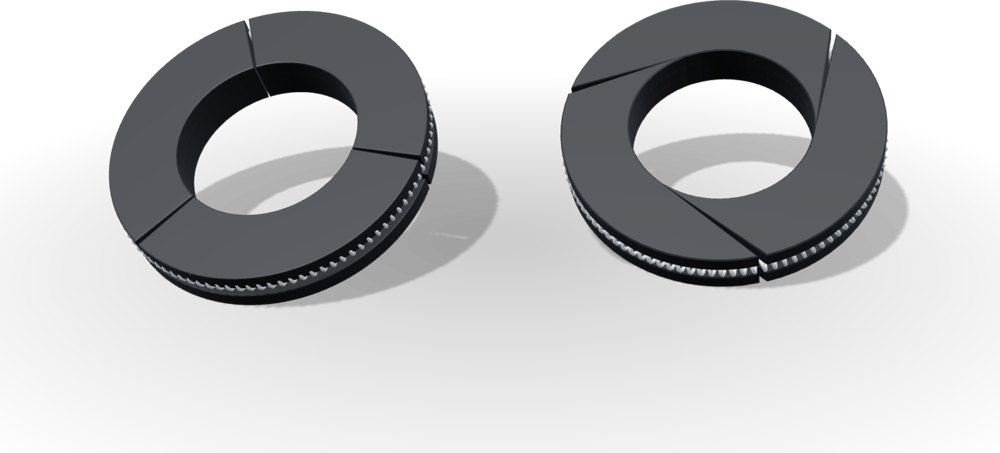
Rod packing rings
Seal the piston rod where it leaves the cylinder, segment by segment.
View details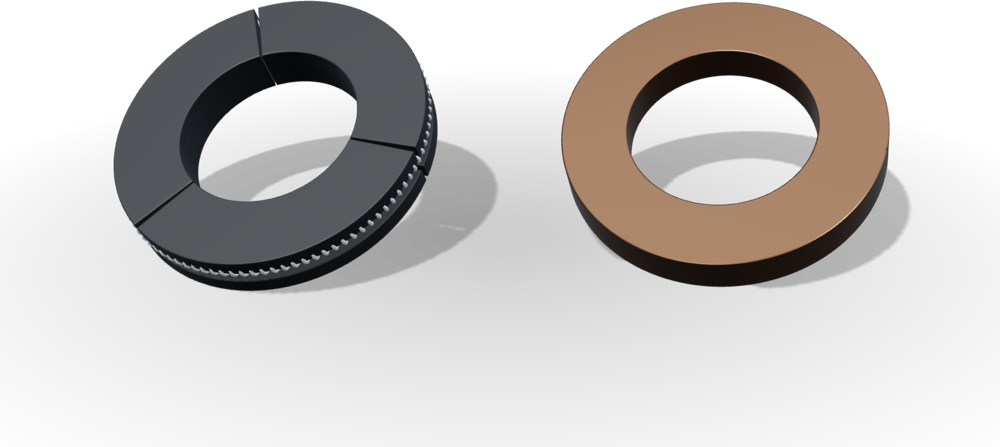
Pressure breaker rings
Absorb pressure pulses at the front of the packing so the sealing rings behind them last longer.
View detailsHave a drawing, a sample or an OEM part number?
Tell us the part, the gas or media, pressure and temperature. We recommend the grade and send a quote.