Rider rings & wear bands
Bands that carry the weight of the piston so metal never touches the cylinder liner.
- Function
- Piston support & guidance
- Materials
- Bronze, carbon, PEEK
- Duty
- Horizontal & vertical
Overview
In a horizontal compressor the piston's weight rests on the rider ring (wear band). The ring acts as a plain bearing between the piston and the liner, so its job is to carry load and wear slowly — not to seal. As it wears, the piston and rod drop, which is why many plants monitor rod drop to schedule replacement.
A rider band must not build up pressure underneath itself, or it starts behaving like a piston ring and wears much faster. That is why rider bands are given slots or grooves across the outer face, and a gap — usually an angled (tangential) cut — that lets gas pass and leaves room for thermal expansion.
Corvex rider rings are made in bronze-, carbon- and graphite-filled PTFE and in PEEK, with slotted outer faces and angled cuts as standard, machined to your piston groove and bore.
Types & designs
- Angle (tangential) cut bandThe most common joint: allows expansion and gas passage without a straight gap.
- Step-cut bandFor pistons where the OEM design calls for a stepped joint.
- Slotted / grooved outer facePressure-relief slots stop gas pressure loading the band.
- Solid or split ringsSolid rings for pistons that can be dismantled; split rings to snap into one-piece pistons.
Materials
- Bronze filled PTFEHigh load capacity and heat conduction — the usual choice for lubricated cylinders.
- Carbon / graphite filled PTFEFor oil-free duty and dry gases.
- Virgin & filled PEEKFor heavy pistons and high bearing loads where PTFE would creep.
Not sure which grade? Compare PTFE grades or ask an engineer.
Gases & duties
- Horizontal reciprocating compressorsAll stages, lubricated and oil-free.
- Process gas & airIncluding hydrogen, nitrogen and hydrocarbon service.
- Pumps & hydraulic cylindersAs guide / wear bands.
How to order
Send us these details and we will recommend the grade and quote quickly:
- Compressor make, model and stage (OEM part no. if known)
- Bore diameter, groove width and depth, band thickness
- Cut type and number / pattern of slots — or a sample
- Piston mass, if available
- Gas, lubricated or oil-free, discharge temperature
- Quantity
Frequently asked questions
Why do rider bands have slots on the outer face?
So gas pressure cannot build up beneath the band. Without relief the band is pressed against the liner like a piston ring and wears out much faster.
When should a rider ring be replaced?
When rod drop or measured wear approaches the limit in your compressor manual — well before the piston can touch the liner.
Related products
View allPiston rings
Seal the compression chamber between piston and cylinder liner, dry-running or lubricated.
View details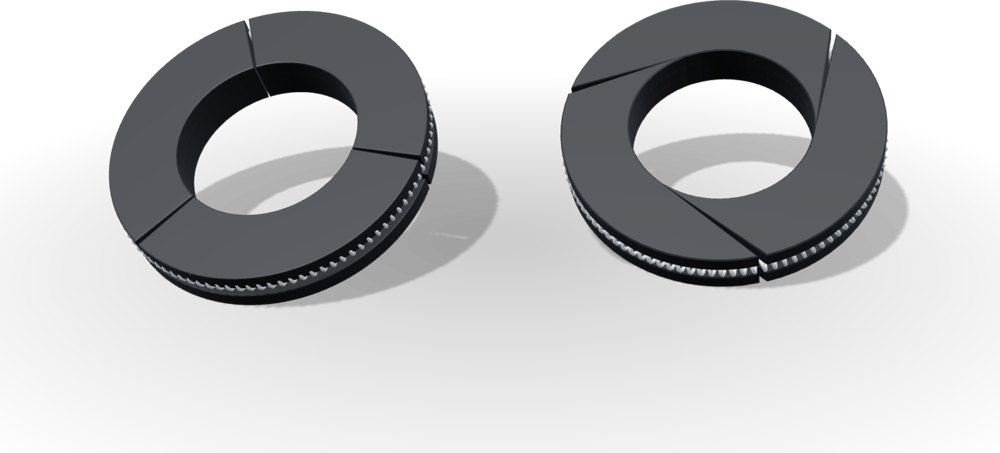
Rod packing rings
Seal the piston rod where it leaves the cylinder, segment by segment.
View details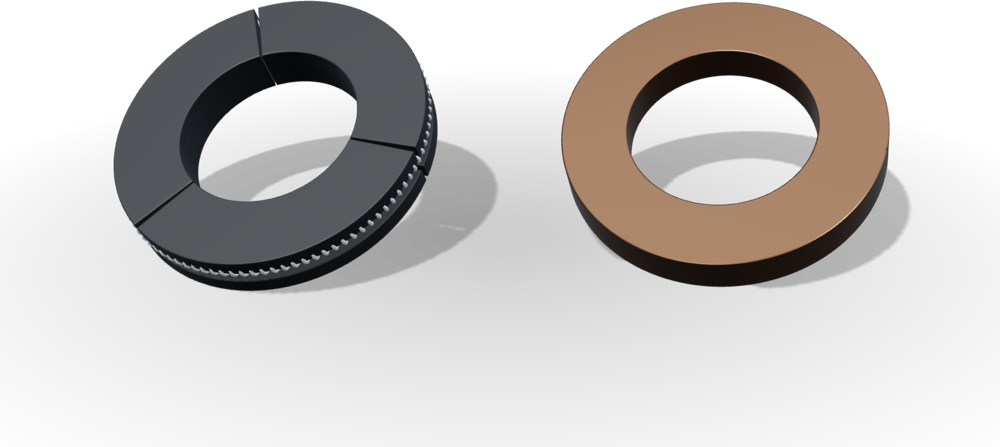
Pressure breaker rings
Absorb pressure pulses at the front of the packing so the sealing rings behind them last longer.
View detailsHave a drawing, a sample or an OEM part number?
Tell us the part, the gas or media, pressure and temperature. We recommend the grade and send a quote.